



Last Updated: November 2, 2026
Quick Summary
Choose paver laying equipment by matching it to your project size, site access and how often you will use it. Hand tools and a plate compactor suit small jobs, while mechanical laying suits larger or repetitive work. Check the paver weight, the layout and the base strength before you buy or hire.
- Small jobs under a few dozen square metres usually need only hand tools and a plate compactor.
- Mechanical laying can place a layer of pavers in one cycle, but it limits pattern flexibility.
- Record your paver length, width, thickness and weight before comparing machine specifications.
- Compare total cost of ownership, including transport, setup and idle time, not just the hire or purchase price.
- Check gate widths, overhead clearance and ground strength before any machine arrives on site.
Table of Contents
- Matching Paver Laying Equipment to Project Size and Scope
- Manual Versus Mechanical Paver Laying: Which Suits Your Job
- When a Paver Laying Machine Is Worth the Investment
- How a Paver Vacuum Lifter Handles Placement
- Checking Site Access, Base Preparation and Equipment Capacity
- Tools Needed for Bedding, Compaction and Cutting
- Booking Your Equipment or Choosing Your Next Piece of Gear
- Frequently Asked Questions
Matching Paver Laying Equipment to Project Size and Scope
Choosing the right paver laying equipment starts with one question: how big is the job? A small garden path and a full driveway need very different tools. Project size, the number of square metres to lay, and how often you will use the gear all shape the decision.
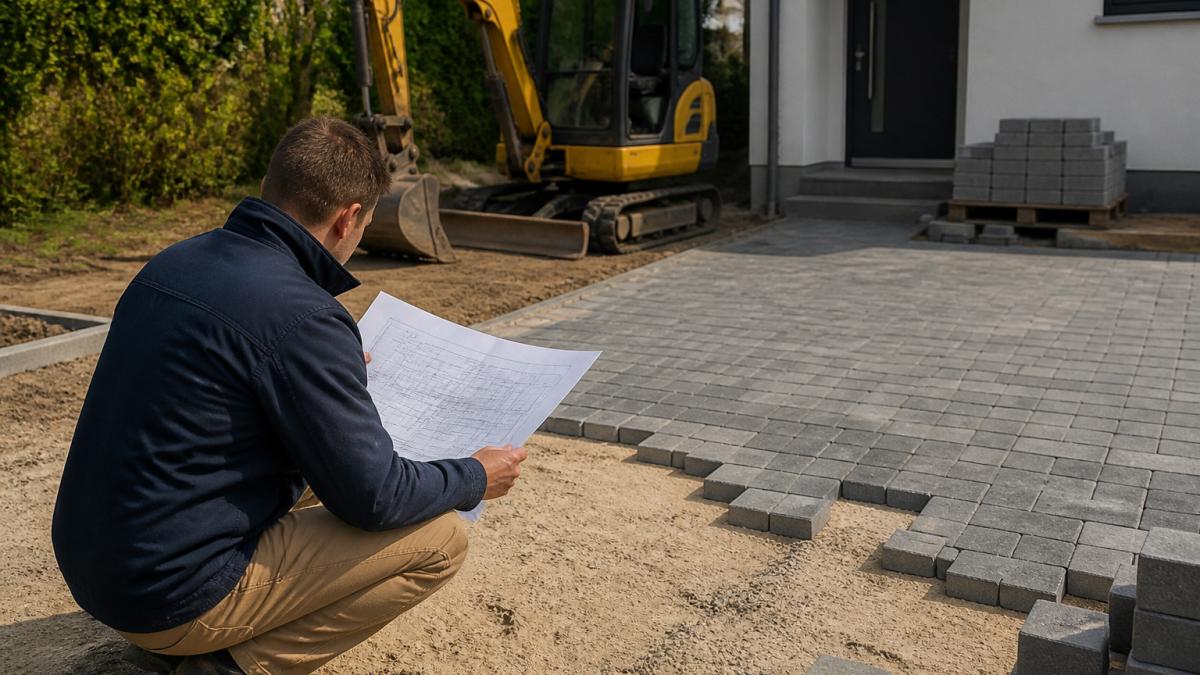
Sites with limited access, tight boundaries or slopes add another layer. Earthmoving Warehouse suggests mapping these conditions before you look at any machine. A manufacturer demonstration reports laying 16,000 square feet in 8 hours with the S19 paver-laying equipment 16k Sq. Ft. in 8 Hours using the S19 Paver Laying Equipment. That is a promotional claim, so treat it as a best-case figure, not a guarantee for your site.
Empire CAT makes the same point in its guide to paving equipment: project scale and project variables drive the choice, not a single universal machine Common Types of Paving Equipment.
A simple way to frame the decision:
- Small jobs (under a few dozen square metres): hand tools and a plate compactor are usually enough.
- Medium jobs: consider mechanical assistance for moving and placing blocks.
- Large or repetitive jobs: a paver laying machine or vacuum lifter may pay for itself in saved labour.
Manual Versus Mechanical Paver Laying: Which Suits Your Job
Manual laying means placing each paver by hand. It gives you full control over patterns and cuts, and it needs no equipment hire. The downside is labour. Every block is lifted, carried and set one at a time, and the repetitive strain on wrists, shoulders and lower back is the main reason crews slow down on larger jobs.
Mechanical laying uses machines to place pavers in succession. The Concrete Masonry & Hardscapes Association notes that specialised equipment can place over a square metre of concrete pavers in succession, rather than one paver at a time Application Guide for Interlocking Concrete Pavements. Mechanical methods are not a fit for every project. Systems described for prearranged layers or successive placement may not suit irregular layouts, small or mixed-material jobs, or tight spaces. Check the layout and paver type before you commit.
The decision is less about preference and more about measurable capacity. Compare the two approaches on the specifications that actually govern output:
| Specification | Manual laying | Mechanical laying |
|---|---|---|
| Typical coverage rate | Roughly 10-20 m² per person per day on straightforward running bond | Machine-dependent; a laying machine can place a layer of pavers in one cycle, so output is limited by supply and alignment rather than by hand speed |
| Paver weight handled per lift | One paver at a time, typically 2-5 kg for a 200 × 100 mm block | Vacuum lifters and grabs are rated by working load limit, often 150-1500 kg depending on the attachment |
| Pattern flexibility | Full, herringbone, basketweave, circles and cut-in details | Limited to the layer configuration the machine or attachment is set up for |
| Setup time | None beyond hand tools | Significant, transport, unloading, commissioning and test placement |
| Minimum viable area | Any size | Usually only economical above a few hundred square metres per project |
| Operator skill | Moderate; pattern and level control learned on the job | Higher; machine operation and attachment compatibility need training |
Equipment capacity and compatibility matter more than the brochure headline. A paver laying machine is configured for a specific paver dimension, weight and layer arrangement, and an attachment that suits one block type may not grip another. Before you compare machines, record the length, width, thickness and weight of your chosen paver, the number of pavers per layer, and the maximum weight the machine or attachment is rated to carry.
Safety and ergonomics should be part of the comparison, not an afterthought. Manual laying exposes operators to cumulative lifting strain, so plan rotation, trolleys and knee pads rather than relying on individual technique. Mechanical laying shifts the risk to machine operation: crush and pinch points around grabs and lifters, stability on slopes, and the need for personal protective equipment including safety footwear, gloves and eye protection.
When a Paver Laying Machine Is Worth the Investment
A paver laying machine makes sense when the job is big enough to use it well, but "big enough" is a calculation, not a feeling. Build the comparison on total cost of ownership rather than sticker price alone, because the purchase or hire figure is usually the smallest line in the sum.
List every cost the equipment brings with it:
- Acquisition: purchase price, or hire rate multiplied by the number of days you actually need the machine.
- Delivery and transport: float charges, loading and unloading, and any permits or escort requirements for wide or heavy equipment.
- Site preparation: the base must be strong enough to carry the machine, which may mean extra compaction or a temporary track.
- Fuel and power: diesel, petrol or battery charging, plus the labour to refuel and maintain charge.
- Maintenance and consumables: filters, belts, hydraulic oil, vacuum pads and grab linings, and scheduled servicing.
- Operator time: training, setup, test placement and pack-down, which can consume a full day on a short hire.
- Idle time: the days the machine sits unused between jobs, which is where ownership costs quietly accumulate.
Compare that total with the labour hours you would otherwise pay for. For a one-off driveway, hire usually wins because the setup and transport costs are spread over too few square metres. For a crew laying pavers most weeks, ownership can cut labour per square metre and shorten programme time, provided the machine is matched to the paver types you actually lay.
Site access and operating constraints can rule out an otherwise suitable machine before cost enters the picture. Check these before you commit:
- Gate and path widths: can the machine, and the vehicle delivering it, reach the work area?
- Overhead clearance: low branches, carports, awnings and power lines limit machine height and boom reach.
- Ground conditions: soft lawns, steep slopes and unstable fill may not carry the machine, and slopes also affect stability and safe operation.
- Turning space: a laying machine needs room to manoeuvre and to be repositioned as the laying face advances.
- Transport requirements: trailer size, ramp angle and tie-down points determine what you can move and how.
If the answers point to a small, one-off project, hiring is usually the smarter move. If you lay pavers every week, owning equipment can cut labour and speed up delivery. Keep the sums honest by writing the total cost of ownership beside the labour hours saved, and revisit the decision when your project mix changes.
Probst FTZ-UNI-15 Block Grabs up to 1500kg →
Watch out: a hire rate that looks cheap per day can become the most expensive option once delivery, setup and operator time are added for a job that only needs the machine for a few hours.
How a Paver Vacuum Lifter Handles Placement
A paver vacuum lifter uses suction to grip and place pavers, which is useful for smooth, sealed surfaces. It keeps the operator's hands clear and reduces the strain of repeated lifting.
Checking Site Access, Base Preparation and Equipment Capacity
Good equipment cannot fix a poor base. Browse our ground preparation tools to find equipment for this stage. Before any machine arrives, check four things:
- Access: Can the machine reach the work area without damaging fences, kerbs or lawns?
- Ground strength: Will the base carry the weight of the equipment?
- Levels and drainage: Is the base graded so water runs away from the pavers?
- Capacity: Does the lifting or placing equipment match the weight and size of your pavers?
Preparing the base properly is also where your equipment pays off. A well-compacted base reduces settling and uneven paving later.
Tools Needed for Bedding, Compaction and Cutting
Beyond the main machine, most paving jobs need a short list of supporting tools:
- Plate compactor: compacts the base and bedding layers.
- Hand tamper: handles small areas and edges.
- Screed rails and a straight edge: level the bedding sand.
- Landscape rake or lute: spreads and smooths bedding sand.
- Wet saw or paver splitter: makes clean cuts around edges and obstacles.
For tight trenches and narrow access points, the MasterPac PMR40R tamping rammer weighs just 46kg and has a 100mm-wide shoe, so it fits where larger rammers cannot.
Pavers themselves are often moved with mechanical grabs. The Probst FTZ-UNI-15 block grab handles a working load limit of 1500 kilograms and grips from 0 to 750 millimetres, which suits concrete blocks, pavers and stone slabs at $4,395.00. For concrete sleepers, the Probst CSG-400 concrete sleeper grab is rated to 400 kilograms with a 30 to 150 millimetre grip range, priced at $995.00.
Check the product specifications against your own pavers before you buy, and confirm the operating conditions in the listing.
Booking Your Equipment or Choosing Your Next Piece of Gear
Once you know your project size, site conditions and budget, you are ready to choose. Start with what you need this month, then think about next year.
If you need equipment for a single job, hire. If you are building a paving business, buy the core machines you will use every week and hire the rest.
Contact the Earthmoving Warehouse team to confirm fit, capacity and availability for your project.
Frequently Asked Questions
What equipment do you need to lay pavers?
The core kit is a plate compactor for the base, a landscape rake and screed rails for bedding sand, a rubber mallet, a string line for alignment, and a paver splitter or wet saw for cuts. For larger areas, a paver laying machine or a vacuum lifter can replace much of the hand placement. The right mix depends on the area, the paver size and how much of the work you want to do by hand. Check each tool's specifications against your paver thickness before buying or hiring.
How do you choose the right paver laying equipment for a project?
Start with the paved area, the number of pavers, the paver size and weight, and how easily machines can reach the site. Small residential areas usually suit manual tools and a vacuum lifter, while larger, open sites with straight runs may justify a mechanical paver laying machine. Compare the equipment's working width, lifting capacity and access requirements against your site, then factor in hire or purchase cost and the time saved on the job.
What is the difference between manual and mechanical paver laying?
Manual laying places each paver by hand, which gives close control over alignment and suits irregular layouts, curves and tight spaces. Mechanical laying uses a machine to place pavers in successive rows, which can cover more area in less time and reduce manual handling. Mechanical systems suit prearranged layers and straight, repeatable layouts, while manual methods remain more flexible for complex patterns.
What safety checks should you make before using paver laying equipment?
Inspect the machine or lifter for damage, worn hoses or lifting points, and confirm it is rated for the paver weight you plan to lift. Check the ground is firm and level enough to support the equipment, and keep bystanders clear of the working zone. Read the manufacturer's operating instructions, and make sure any operator has been trained on the specific equipment before work begins.


