



Quick Summary
To choose the right hydraulic hose fittings, first identify the machine port by its gender, thread standard and sealing face. Then measure the hose inside diameter across the bore and check that the fitting's pressure and temperature ratings suit your system.
- Confirm whether the machine port is male or female before ordering any fitting.
- Measure thread diameter and pitch in millimetres with a thread gauge or calliper.
- Measure hose inside diameter across the bore, not the outside of the hose.
- Rate the fitting above the system's maximum pressure, including pressure spikes.
- Check fitting, hose and seal materials against your hydraulic fluid and its temperature range.
Table of Contents
- Why the Right Hydraulic Hose Fitting Matters on Site
- Hydraulic Fitting Types and Connection Standards
- How to Identify Hydraulic Fittings
- Hydraulic Hose Fitting Sizes: Measuring Hose Inside Diameter and Thread Size
- Checking Pressure Ratings, Temperature Limits and Hose Compatibility
- A Step-by-Step Decision Process for Choosing Your Fitting
- Booking Your Fitting Check Before You Order
- Frequently Asked Questions
7 Steps to Choose the Right Hydraulic Hose Fitting
Last Updated: November 21, 2026
Why the Right Hydraulic Hose Fitting Matters on Site
Picking the wrong hydraulic hose fittings can stop a machine dead. A small mismatch in thread or size can turn into hours of lost time on site. The good news is that choosing the right hydraulic hose fitting is a process you can follow step by step.
Hydraulic hose fittings do more than join two lines. They have to hold system pressure, seal against leaks, and survive the heat, vibration and knocks of daily work. A fitting that looks close enough can still fail under load.
Most problems come from a few predictable mistakes:
- Guessing the thread instead of measuring it
- Mixing up male and female ends
- Ignoring the pressure rating of the system
- Forgetting the temperature range of the job
If you want background on the engineering behind reliable lifting and hydraulic equipment, Probst Lifting Equipment's guide to German engineering explains how manufacturers approach it.
Hydraulic Fitting Types and Connection Standards
Hydraulic fittings come in several families, and each one connects in its own way. The most common types include threaded fittings, flared fittings, flange connections and quick couplers. Each type seals differently, so the connection you choose has to match the port on your machine.
Connection standards matter just as much as the shape of the fitting. A metric fitting will not reliably seal on an imperial port, even when the thread looks similar. Check the standard on your equipment before you order anything.
Many fitting problems come from mixing standards. A fitting from one system is often forced onto another, and the result is a slow leak or a stripped thread. When in doubt, bring the old fitting or a clear photo to your supplier.
The main fitting families and what each one is typically used for, as covered in this section:
| Fitting type | Connection feature | Key point |
|---|---|---|
| Threaded fittings | Screws into a port | Thread and seal must match the port |
| Flared fittings | Flared cone seal | Seal differs from a flat face or O-ring |
| Flange connections | Bolted flange joint | Used for larger connections |
| Quick couplers | Fast-connect joint | Quick to connect and disconnect |
How to Identify Hydraulic Fittings
Identifying a fitting takes only a few minutes with the right approach, but the cost of getting it wrong is high. Start by looking at the end of the fitting that is already on the machine, and note how it connects. Work through the checks below in order and write each result down before you order anything.
!A mechanic in workwear holding a hydraulic hose fitting up to a thread gauge on a workbench in a well-lit workshop
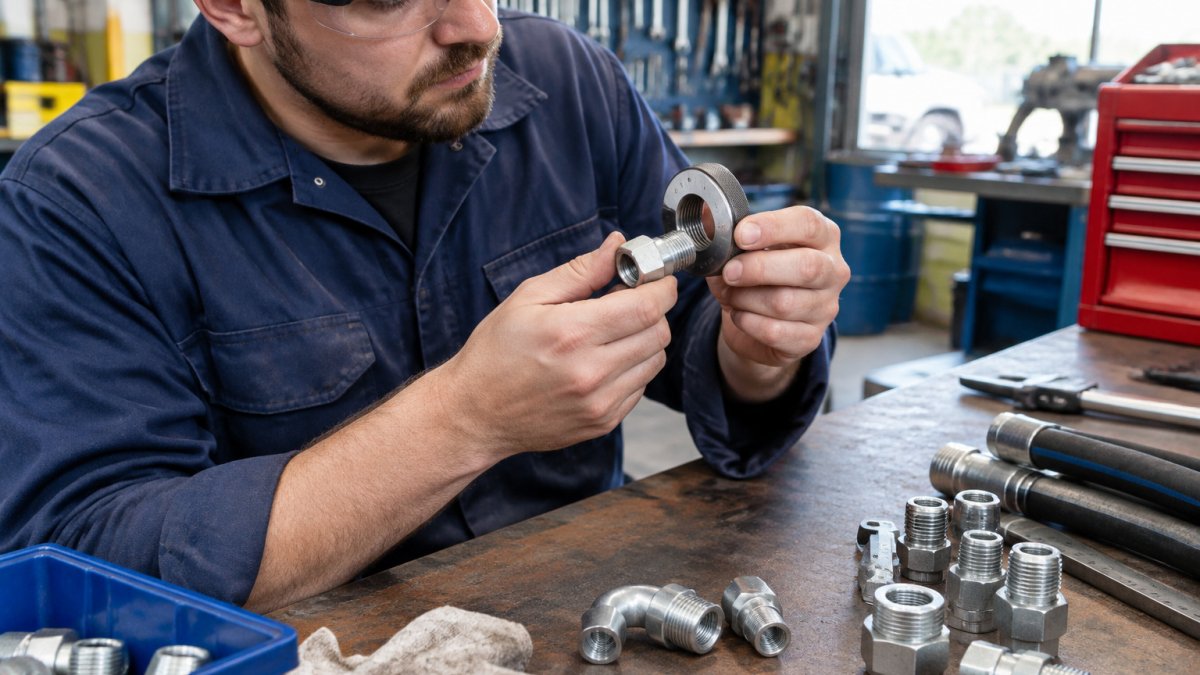
- Look at the fitting shape and the sealing face. Is it a threaded end, a flared cone, a flat face with an O-ring, a flange, or a quick coupler? The sealing method tells you which family the fitting belongs to.
- Check whether the thread is on the inside or the outside. This determines male versus female, which is covered below.
- Measure the thread diameter and pitch with a thread gauge or calliper. Record both numbers in millimetres. Pitch is the distance between thread crests and is the detail most often skipped.
- Note the seal type. A flat face, a cone (37° or 45°), or an O-ring each requires a matching port. A cone fitting will not seal against a flat face, even if the thread engages.
- Record the hose inside diameter. Measure across the bore, not the outside of the hose.
- Note the thread standard if you can identify it. Common families include BSPP (parallel), BSPT (tapered), NPT, JIC, SAE ORFS and metric DIN. The standard is often stamped on the fitting body or the port.
A common pattern is for two fittings to look almost identical but belong to different standards. BSPP and NPT threads, for example, have different thread angles and will not seal against each other even when the diameter appears close. Forcing one into the other damages the port and creates a leak path that no amount of tightening will fix. If you cannot confirm the standard from the fitting or the machine documentation, take the old fitting or a clear photo to your supplier rather than guessing.
Male Versus Female Threads
A male thread sits on the outside of the fitting and screws into a female port. A female thread sits inside and receives a male end. Getting this right is the first check on any hydraulic connection.
Look at the port on the machine. If it has threads on the inside, you need a male fitting. If the port has threads on the outside, you need a female fitting. A male-to-male or female-to-female mismatch cannot be corrected with an adapter without adding another potential leak point, so confirm the port gender before ordering.
Parallel Versus Tapered Threads
Parallel threads keep the same diameter along their length and rely on a seal, an O-ring, a bonded washer or a cone, to stop leaks. Tapered threads get narrower toward the tip, and the taper itself creates the seal as the threads deform against the port when tightened.
Using a parallel fitting in a tapered port, or the reverse, can leak under pressure. A parallel thread in a tapered port will not bottom out correctly, and a tapered thread forced into a parallel port can crack the housing. Check the thread profile by eye and with a gauge. If the thread narrows as it goes in, it is tapered. If it stays the same width, it is parallel. When the profile is ambiguous, a thread pitch gauge and a known reference fitting are the quickest way to settle it.
Hydraulic Hose Fitting Sizes: Measuring Hose Inside Diameter and Thread Size
Size is where many buyers go wrong. You need two measurements: the hose inside diameter and the thread size of the connection.
Measure the hose inside diameter across the bore of the hose, not the outside. Measure the thread with a thread gauge or calliper, checking both diameter and pitch. Keep your measurements in millimetres to avoid mix-ups.
Match both numbers to the fitting you want. A fitting that matches the thread but not the hose bore will not work, and the reverse is also true.
Checking Pressure Ratings, Temperature Limits and Hose Compatibility
Every fitting carries a working pressure rating, and it must meet or exceed the maximum pressure of your system. For guidance on when components need attention over time, see the excavator bucket teeth replacement frequency guide. Never choose a fitting based on thread size alone. Check the rating on the fitting or its documentation.
Temperature matters too. Hot fluid softens seals and can cause fittings to fail early. Check the fluid temperature range of your system and make sure the fitting and hose are rated for it.
Hose and fitting compatibility also depends on the fluid. Check that the fitting and hose materials suit your hydraulic fluid. A mismatch can cause swelling, cracking or leaks.
Watch out: a fitting rated for low pressure can burst under a spike in a high-pressure system. Always design around the highest pressure the machine can produce, not the normal working pressure.
A Step-by-Step Decision Process for Choosing Your Fitting
Use this process each time you need a new fitting. It moves from identifying the connection through to verifying the assembly, which is where most selection guides stop too early.
- Identify the machine port. Confirm whether it is male or female, and check the thread standard against the machine documentation or a reference gauge.
- Measure the thread. Record the diameter, pitch and whether it is parallel or tapered. Note the seal type, flat face, cone or O-ring.
- Measure the hose. Record the hose inside diameter across the bore, and confirm the hose type and rated working pressure.
- Check the pressure rating. Make sure the fitting meets or beats the system's maximum pressure, including pressure spikes, not just the normal working pressure.
- Check the temperature range. Confirm the fitting, hose and seal materials suit the fluid temperature of the job, including start-up and peak conditions.
- Confirm material and fluid compatibility. Check that the fitting and hose materials suit your hydraulic fluid, and that the seal material suits both the fluid and the temperature.
- Verify the assembly before pressurising. Confirm the crimp or assembly specification matches the hose and fitting combination, check that the fitting is fully seated, and inspect for crossed threads before the system is pressurised.
Worked example, mobile plant hydraulic return line. Suppose a machine has a port with a parallel BSPP female thread and a flat sealing face, and the hose bore measures 12.7 mm (½ inch).
Safety procedures around inspection and replacement. Before removing any fitting, depressurise the system and isolate it according to the machine manufacturer's procedure. Hydraulic fluid injection injuries from pinhole leaks are serious and require immediate medical attention, never run a hand over a pressurised line to check for leaks; use a piece of cardboard or paper instead. After assembly, pressurise slowly and check every joint for weeping before returning the machine to service.
Failure diagnosis. Most fitting failures trace back to a small number of causes: a mismatched thread standard that was forced together, a seal that is incompatible with the fluid or temperature, a fitting rated below the system's peak pressure, or an assembly that was not crimped to specification.
If any step leaves you unsure, stop and check before buying. Guessing is the main cause of wasted money and repeat failures.
Booking Your Fitting Check Before You Order
If you are unsure about a fitting, the fastest route is a quick check before you order. The Earthmoving Warehouse team can help confirm thread, size and pressure details against your machine.
Pricing depends on the fitting, quantity and delivery, so request a quote for current figures. Contact the Earthmoving Warehouse team to confirm the right fitting for your equipment before you buy.
Frequently Asked Questions
How do I identify a hydraulic hose fitting?
Start by checking the thread form, the connection end and the sealing method. Look at whether the thread is male or female, whether it is parallel or tapered, and whether the seal is a flat seal, an O-ring or a cone seal. Compare what you find against the fitting's markings and the connection on your machine. If the markings are worn or missing, take the part to a qualified hydraulic technician or your supplier for confirmation before fitting it. Guessing a thread type is a common reason for leaks and damaged ports.
How do I measure hydraulic hose fitting size?
Measure the hose inside diameter first, then identify the thread size and pitch of the fitting end. A thread gauge helps confirm pitch, and calipers help confirm the hose bore and fitting dimensions. Record each measurement before ordering so the hose, fitting and port all match. Do not rely on the outside diameter of a hose to determine its size, because hydraulic hose sizing is based on the inside diameter.
Are hydraulic hose fittings interchangeable?
Not always. Fittings can look similar but use different thread forms, angles or seal types, and mixing them can cause leaks or thread damage. Two fittings are only interchangeable when the thread type, thread size, pitch, seal method and pressure rating all match. Confirm compatibility with the hose manufacturer's specifications and the equipment's port details before assuming a substitute will work.
Can I use an adapter to connect different hydraulic fittings?
An adapter can bridge two different connections, but each joint adds a potential leak point and must be rated for the system's working pressure and temperature. Check that the adapter's thread types and seal types match both ends, and that the combined assembly does not exceed the lowest-rated component. Where the system is safety critical or the pressures are high, ask a qualified hydraulic technician to verify the assembly before it goes into service.


