



Last Updated: November 12, 2026
Quick Summary
Hardened steel pins resist wear and fatigue because induction hardening creates a hard outer case over a tough core, so the surface resists abrasion and scoring while the core absorbs bending and shock without cracking. This keeps the pin diameter within specification far longer, protecting the bushings around it from the impact that follows once clearance develops.
- Induction hardening heats and quenches the pin's outer layer, producing a hard case over a tougher core.
- Push surface hardness too high and the pin becomes brittle, resisting abrasion but cracking under impact.
- Hardness depth matters as much as peak value, because a shallow case wears through once the pin flexes.
- Grease at the end of the shift and pump until fresh grease appears at the seal.
- Measure the worn pin and the boss bore, not just the pin, before ordering.
Table of Contents
- What Excavator Pins and Bucket Pins Actually Do
- How Hardened Steel Pins Resist Wear and Fatigue
- Signs of Worn Excavator Pins You Should Not Ignore
- Pin Materials and Heat Treatment: A Selection Guide
- Best Practices for Greasing Excavator Pins
- How to Measure Excavator Bucket Pins Before You Order
- Request a Price on Hardened Steel Pins for Your Fleet
- Frequently Asked Questions
What Excavator Pins and Bucket Pins Actually Do
A bucket pin is the pivot that carries the entire working load of the attachment, and its job is harder than most operators give it credit for. Every scoop, every breakout force, every rock strike travels through that steel cylinder and into the bushings around it. When we talk about the benefits of hardened steel excavator pins, we are really talking about how that pivot survives thousands of load cycles without ovalising, scoring or seizing.
Pins and bushes for machines that spend their days in rock, clay and demolition rubble are where wear usually shows first. The pattern is consistent: soft pins wear fast, wear creates clearance, clearance creates impact, and impact destroys the joint. Hardened steel pins interrupt that chain at the first link.
Three forces act on a bucket pin at once:
- Bearing load from the bucket and dipper weight
- Hydraulic breakout force transmitted through the linkage
- Impact load every time the bucket contacts ground or rock
A link pin on the crowd linkage sees a different mix again, often more shock and less steady load. That distinction matters when you select a pin, because a steel grade that suits one position may be the wrong choice for another.
How Hardened Steel Pins Resist Wear and Fatigue
Hardening works by changing the surface of the steel, not just its bulk. Induction hardening heats the outer layer of a pin rapidly and quenches it, producing a hard case over a tougher core. That combination is the whole point: a hard surface resists abrasion and scoring, while a softer core absorbs bending and shock without cracking.
Surface hardness is usually expressed on the Rockwell C scale, written as HRC. Higher HRC means better wear resistance, but there is a ceiling. A practical machinist discussion on excavator pin material makes the point that hardness has to be balanced against core strength, bending resistance and fatigue life, particularly on larger pins. Push surface hardness too high and the pin becomes brittle, so it resists abrasion but cracks under impact.
Hardness depth matters as much as the peak value. A shallow case wears through quickly once the pin starts flexing; a deeper hardened layer keeps the wear surface intact for far longer.
Where does the wear actually come from? Mostly from the pin-and-bushing joint. Grease film breaks down, metal contacts metal, and abrasion begins. A hardened pin holds its diameter far longer under that friction, which keeps clearance within specification and protects the bushing from the hammering that follows once play develops.
Signs of Worn Excavator Pins You Should Not Ignore
Watch for three things: grease weeping from the joint, visible movement when you rock the bucket, and a wear step you can feel with a fingernail. Any one of them means the pin is past its best and the bushing is likely following close behind.
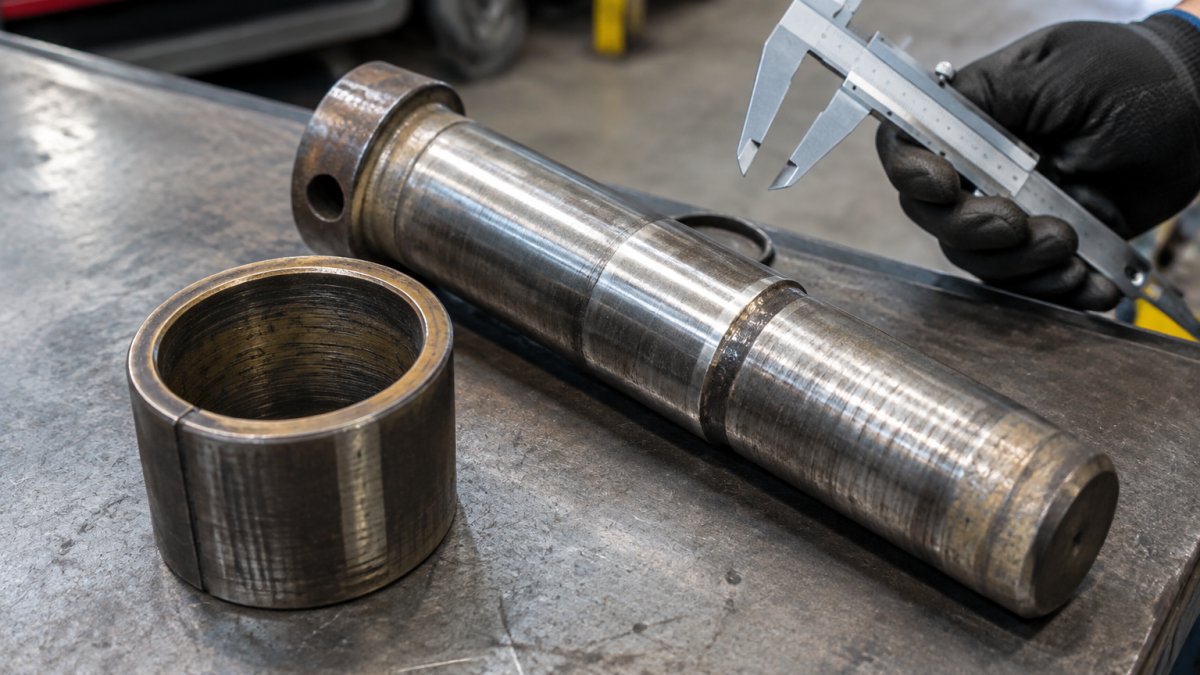
The full list of signs of worn excavator pins we would check on any machine:
- Scoring and galling on the pin surface, often running lengthwise
- A wear step where the pin sits against the bushing edge
- Ovality rather than a true round section
- Cracking at the pin ends or around grease ports
- Excess clearance in the joint, felt as a clunk when you change bucket direction
- Grease leaking out almost as fast as you pump it in
Catching these early is the difference between replacing a pin and replacing a pin, a bush and possibly a boss. Deformation and cracking are the warning signs that matter most: a cracked pin can shear without much notice, and that is a machine-down event on any site.
Pin Materials and Heat Treatment: A Selection Guide
Material selection comes down to loading conditions, not brand loyalty. Ordinary carbon steel is easy to machine and versatile, but a guide to excavator bucket pins and bushings notes that it offers only average resistance to lateral forces under heavy loads. That is fine for light-duty work and a poor choice for a rock bucket on a large excavator.
Most pins in this market fall into a few practical families. Medium-carbon steels such as 1045 or 4140 are common because they can be through-hardened or induction-hardened and still retain a tough core. Through-hardening treats the whole section, which suits smaller pins and link positions where bending loads are modest.
Use this as a starting framework:
| Application | Typical pin approach | Why |
|---|---|---|
| Light-duty trenching, general earthworks | Medium-carbon steel, through-hardened | Adequate wear life, lower cost, easy to machine |
| Rock buckets, demolition, heavy breakout | Induction-hardened case over a tough core | Balances abrasion resistance with impact strength |
| Link pins under shock loading | Hardened with generous core toughness | Resists fatigue and bending rather than pure abrasion |
| High-corrosion environments | Hardened pin with chrome plating | Adds corrosion resistance to wear resistance |
| Large-diameter pins in high-bending positions | Induction-hardened with controlled case depth | Avoids a brittle case that can crack under flex |
The trade-off is real. A hardened pin costs more up front than a soft one, but it holds its fit and protects the bushings around it. We would rather see a customer spend once on a properly hardened pin than replace a soft pin three times and a bush alongside it.
Watch out: specifying the hardest available pin without checking core toughness is a common mistake. On large pins carrying heavy bending loads, an over-hard case can lead to cracking rather than wear. Ask for the hardness range and the case depth, not just a single peak HRC figure, and match the pin to the position it will work in.
Best Practices for Greasing Excavator Pins
Greasing is the cheapest maintenance you will ever do, and it is where most premature pin wear starts. Grease does two jobs: it separates the pin and bushing surfaces, and it flushes out grit and water that would otherwise grind the joint from the inside. A hardened pin and a soft pin both depend on that film, but they fail differently: a soft pin wears away quickly once the film breaks down, while a hardened pin can survive brief metal-to-metal contact but will still score if contamination is allowed to persist.
Our best practices for greasing excavator pins:
- Grease at the end of the shift, while the joint is warm and old grease is soft
- Pump until fresh grease appears at the seal, not just two or three strokes
- Wipe the fitting first so you are not injecting dirt
- Check seals and boots and replace them when they split, because a failed seal lets abrasion in
- Keep a written schedule per machine, especially across a mixed fleet
- Match the grease interval to the duty cycle, not just the calendar; a machine in rock or demolition rubble needs more frequent attention than one on general earthworks
A joint that will not take grease is telling you something. Either the fitting is blocked, the grease passage is plugged, or the pin has worn enough to close the clearance. Investigate it the same day rather than adding it to a list. The same applies when grease weeps out almost as fast as you pump it in: that usually points to a failed seal or excess clearance, and a hardened replacement pin will not fix a joint that is already loose.
Watch out: relying on a hardened pin to compensate for poor greasing is a false economy. Hardness buys wear resistance at the surface, but it does not replace the grease film that keeps abrasive grit out of the joint.
How to Measure Excavator Bucket Pins Before You Order
Measure the worn pin and the boss bore, not just the pin. A pin that matches the original diameter will still fit badly if the bore has opened up, and that is how customers end up grinding and modifying parts on arrival.
How to measure excavator bucket pins properly:
- Clean the pin and remove all grease and burrs
- Measure the pin diameter at three points along its length with a vernier or micrometer, and record the smallest reading
- Measure the bore diameter at the boss with an internal gauge
- Compare the difference to the specified clearance for your machine
- Record the pin length, the head or retaining configuration, and any grease port position
- Photograph the pin and the joint before you call
If the bore is worn beyond specification, a new pin alone will not fix the joint. That is the point where a bush replacement, or a repair sleeve system, becomes the sensible route. A case report on an Expander System for an excavator bucket describes how a pivot repair system addressed bucket-pivot wear and removed the need to take machines out of service for pin wear, which is the kind of alternative worth discussing before you commit to a rebuild.
Send us those measurements and photos and our team will verify fitment before anything ships. That is how we would rather work than have you discover a mismatch on site.
Request a Price on Hardened Steel Pins for Your Fleet
The challenge with pins is rarely finding something that fits; it is finding a pin that still fits after a season of rock work. Soft pins wear, wear opens clearance, and clearance takes out the bushings behind it.
Earthmoving Warehouse has been operating since 2019 and is Queensland's only Kato construction equipment dealer. Our expert team can help with technical assistance and fitment verification, and with pickup locations across South East Queensland, New South Wales and Victoria and nationwide shipping, you can get the right part to your machine efficiently. For current pricing, request a quote through our website.
Get started with Earthmoving Warehouse and keep your fleet working instead of waiting on parts.
Send through your pin measurements, machine model and photos of the worn joint, and we will come back with the right hardened steel pins and a price for your fleet.
Frequently Asked Questions
Why is heat treatment important for excavator pins?
Heat treatment sets the balance between surface hardness and core toughness. Induction hardening raises surface hardness so the pin resists abrasion and scoring against the bushing, while the untreated core keeps bending resistance and fatigue life. Get the balance wrong and a pin either wears quickly or cracks under impact.
What is the difference between hardened steel and standard steel pins?
Standard pins are usually made from ordinary carbon steel, which is easy to machine and versatile but offers only average resistance to lateral forces under heavy loads, according to parts supplier GFM Parts. Hardened steel pins go through controlled heat treatment, typically induction or case hardening, so the outer surface reaches a specified Rockwell hardness while the core stays softer. That combination improves wear resistance and fatigue strength without making the pin brittle.
Do hardened steel pins reduce wear on excavator bushes?
They can, but only as part of a matched pin-and-bushing joint. A hard, smooth pin surface lowers friction and abrasion against the bush, and keeping the clearance within specification stops the pin rocking and hammering the bush bore. Greasing on schedule and sealing out dirt matter just as much. If the bush is already worn oval, fitting a new hardened pin alone will not restore the joint.
Can using the wrong pin material damage my excavator attachment?
Yes. A pin that is too hard throughout can crack under impact load, and a pin that is too soft deforms and wears the bushing faster. Forum discussion on excavator pin material notes that hardness has to be balanced against core strength, bending resistance and fatigue life, particularly on larger pins. Always match the pin to the machine, the attachment and the working conditions, and confirm fitment before ordering.


