



Last Updated: November 4, 2026
Quick Summary
Hydraulic hose abrasion is prevented by routing hoses so they never rub against frames, edges or other hoses, leaving enough slack for full machine movement, and protecting contact points with sleeves or guards. Check every hose weekly for scuffs, exposed wire and oil seepage, and replace worn protection rather than patching it.
- Hydraulic hoses fail from rubbing more often than from pressure.
- Leave enough slack for full boom and arm movement so hoses never pull tight.
- Keep bends at least as wide as the manufacturer's minimum bend radius.
- Use spiral wrap on flexing sections and metal guards on high-impact zones.
- Walk around the machine weekly and check every visible hose for wear.
Table of Contents
- Why Abrasion Is the Leading Cause of Hydraulic Hose Failure
- How to Route Hydraulic Hoses to Avoid Contact Damage
- Choosing the Right Hydraulic Hose Protective Sleeve Types
- Step-by-Step: Fitting Protection to Your Hoses
- Cost-Benefit: Protection Methods Compared
- Signs of Hydraulic Hose Failure to Check For Each Week
- Booking Your Hose Protection Upgrade and Fitment Check
- Frequently Asked Questions
Hydraulic hoses fail far more often from rubbing than from pressure. Hydraulic hose abrasion is a common cause of hose failure in the field, and much of that wear is avoidable. Earthmoving Warehouse supplies attachments and couplers for excavators and skid steers. This guide shows you how to find the risk points, route and protect your hoses properly, and check them before small wear turns into an unplanned breakdown.
Why Abrasion Is the Leading Cause of Hydraulic Hose Failure
Hydraulic hoses can wear through from the outside in, with abrasion as a frequent cause.
Abrasion happens when a hose rubs against a surface it should never touch. Common culprits include:
- Steel structures, frame edges and boom members
- Other hoses bundled too tightly together
- Rocks, gravel and debris caught between hose and machine
- Vibration that keeps the hose moving against the same spot
Visible abrasion marks and missing insulation are direct signs of poor routing and missing protection. IMCA Safety Flash on hydraulic hose wear and routing describes this pattern clearly, and it is a useful checklist for any operator.
The damage is slow. A hose may look fine for months, then fail suddenly when the outer cover finally gives way.
How to Route Hydraulic Hoses to Avoid Contact Damage
Good routing is the cheapest protection you can give a hose. Before you add any sleeve or guard, check the path the hose takes.
Allowing for Movement and Flex
Hoses move as the boom, stick and bucket work. A hose that is too short gets pulled tight at full extension. A hose that is too long flaps and rubs.
- Leave enough slack for the full range of boom and arm movement
- Check that the hose does not pull tight at maximum reach or full curl
- Secure the hose at fixed points so the movement happens in one predictable loop
A quick test: cycle the machine through its full range and watch the hose. Any point where it pinches, drags or rubs needs fixing.
Avoiding Sharp Bends and Kinks
Every hose has a minimum bend radius. Tighter bends stress the reinforcement layer and speed up wear on the outside cover.
- Keep bends as wide as the hose manufacturer specifies
- Use elbow fittings where space is tight, rather than forcing a hose round a corner
- Never let a hose kink where it leaves a fitting
Choosing the Right Hydraulic Hose Protective Sleeve Types
When routing alone cannot keep a hose clear of contact points, add protection. The main families are nylon sleeves, spiral wraps, and metal guards, and each suits a different combination of movement, impact and access. Choose by asking four questions: how much does the hose flex, what is it rubbing against, can the fittings be removed, and how much weight can the machine carry at that point.
Nylon Abrasion Sleeves and Spiral Wraps
Nylon sleeves and spiral wraps are the most common choice for mobile equipment.
Spiral wraps are easy to fit around an existing hose, even after it is installed. Full sleeves give more continuous coverage but must be slid on before the hose fittings are attached. A common pattern is to use spiral wrap on the flexing sections between the boom and the stick, and full sleeve on long straight runs that sit against a frame.
Consider nylon protection when:
- The hose has to flex often
- Weight matters on a smaller machine
- You need protection that is quick to fit or replace
- The main risk is rubbing rather than sharp impact
Watch out: spiral wrap that is fitted too loosely will migrate along the hose under vibration and leave the original contact point exposed.
Metal Guards and Their Trade-offs
Metal guards offer strong protection against sharp rock and heavy impact. They suit high-impact spots on demolition machines or rock breakers, and on the lower boom where debris is thrown up.
They also have limits. Some operators find that rigid guards reduce hose flexibility or create new pinch points if fitted badly. Check the clearance at full movement before you tighten anything down, and confirm the guard does not sit where it can trap grit against the hose cover.
Use metal guards for the highest-impact points, and nylon wraps for the rest of the run.
Matching Protection to the Environment
A common gap in generic advice is that it treats every site the same. In practice the environment drives the choice:
1/2" Flat Faced Couplers (Pair - Female and Male) →
- Construction and demolition: impact and sharp debris dominate, so metal guards on the lower boom and nylon on flexing sections.
- Earthmoving and quarry work: constant vibration and rock contact, so full nylon sleeve on long runs plus regular rechecking of clamps.
- Marine and wash-down areas: moisture and salt attack the cover once it is breached, so prioritise continuous coverage and inspect more often.
- High-heat industrial areas: check that the sleeve material is rated for the ambient temperature before fitting, because some plastics soften and sag against a hot surface.
Fitting Constraints That Decide the Choice
Before ordering, confirm whether the hose can be disconnected. Full sleeves and most metal guards must be slid on before the fittings are crimped, so they suit new hose builds or planned replacements. Spiral wrap is the practical option for retrofitting protection to hoses that are already installed and cannot be taken off the machine.
Also check the minimum bend radius with the sleeve fitted. A sleeve adds thickness, and a bend that was acceptable on the bare hose may now be tighter than the manufacturer allows. If the routing is already near the limit, fix the routing first and add protection second.
Step-by-Step: Fitting Protection to Your Hoses
This process takes around 30 to 45 minutes per hose, depending on length and access.
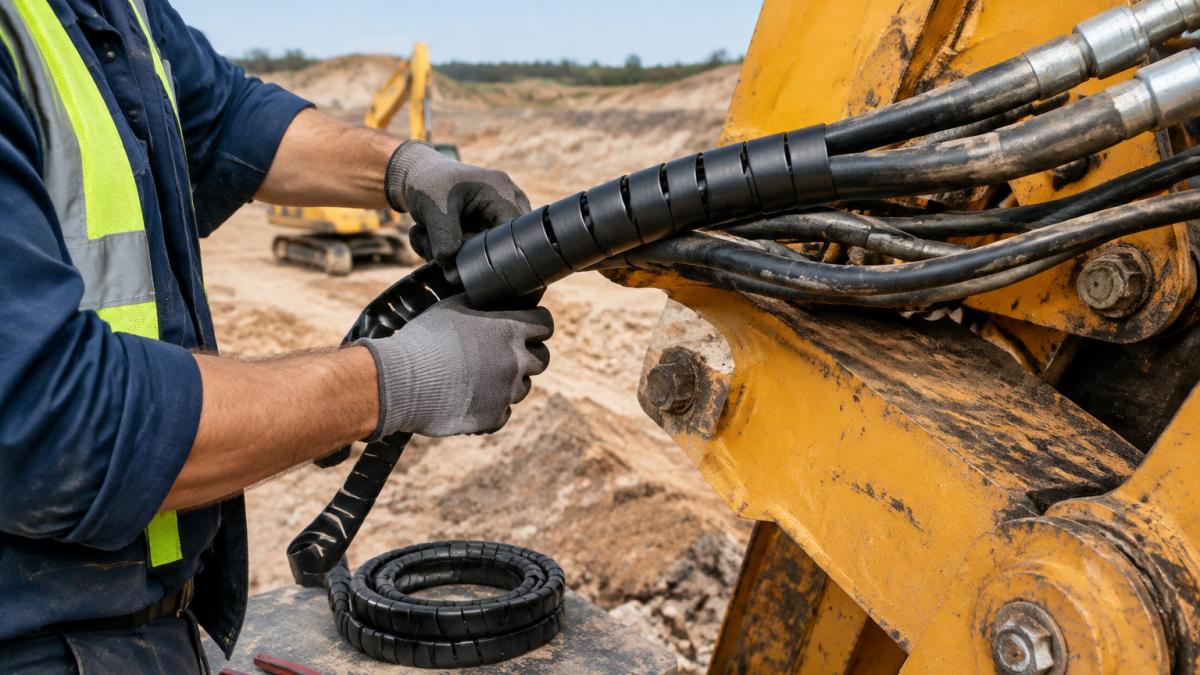
- Clean the hose. Remove dirt and grit so the wrap sits flat.
- Mark the contact points. Run the machine through its full range and note every rub mark.
- Choose the protection. Use spiral wrap for flexing sections and metal guards for impact zones.
- Start at the fitting end. Wrap the spiral tightly, overlapping each turn by about half its width.
- Secure both ends. Use cable ties or clamps so the wrap cannot unwind.
- Recheck the clearance. Cycle the machine again and confirm no new rub points appear.
Plan to replace worn sleeves rather than patching them. Once the cover is breached, moisture and grit get in quickly.
Cost-Benefit: Protection Methods Compared
Most guides list protection options but stop short of helping you choose between them on cost and durability. This section does that, using the factors that actually drive the decision: upfront labour, replacement frequency, and the cost of a failure.
The Real Cost of a Failed Hose
A hose failure costs more than the part. The part is usually the smallest line. The larger costs are machine downtime, call-out time, the labour to replace the hose in the field, and the cost of a missed job or late delivery. On a busy site, a single unplanned stop can outweigh the protection cost for the whole machine many times over.
A useful way to frame it is cost per operating hour. Divide the protection cost by the hours you expect it to last, then compare that with the expected cost of one failure multiplied by how often failures occur without protection.
Comparing the Options
| Method | Upfront cost | Labour to fit | Durability | Best for | Main drawback |
|---|---|---|---|---|---|
| Routing changes | Low (labour only) | Moderate | Permanent | Fixing bad layouts | Limited where space is tight |
| Spiral nylon wrap | Low | Low | Wears and needs replacing | Flexing sections, retrofits | Can migrate if not secured |
| Full nylon sleeve | Low to moderate | Moderate (fittings off) | Good on continuous contact | Long runs with constant contact | Must be fitted before fittings |
| Metal guard | Moderate | Moderate | High against impact | High-impact points | Can restrict flex |
Choosing on Budget Versus Durability
If the budget is tight, start with routing changes and spiral wrap on the worst rub points.
If durability is the priority, move to full nylon sleeve on long runs and metal guards on impact zones. The higher upfront cost is offset by fewer replacements and less downtime.
A common pattern is a staged approach: fix routing and add spiral wrap first, then upgrade to full sleeve or guards as hoses come up for planned replacement.
Watch out: comparing only the purchase price of a sleeve against the price of a hose understates the case for protection, because it ignores the downtime and labour that dominate the cost of a failure.
A Simple Decision Rule
- If the hose flexes and cannot be removed: spiral wrap.
- If the hose is on a long straight run against a frame: full nylon sleeve, fitted at build.
- If the hose sits in an impact zone: metal guard, with clearance checked at full movement.
- If the hose rubs because of bad routing: fix the routing first, then protect.
Plan to replace worn sleeves rather than patching them. Once the cover is breached, moisture and grit get in quickly, and the cost of a replacement sleeve is small against the cost of the hose it protects.
Signs of Hydraulic Hose Failure to Check For Each Week
Walk around the machine once a week and check every hose you can see. Look for:
- Scuffed or shiny patches on the outer cover
- Exposed reinforcement wire or braid
- Bulges, blisters or soft spots
- Cracks near fittings
- Oil seepage or wet patches on the hose
- Hoses rubbing against each other or a structure
Catch these early and the fix is usually a new sleeve. Ignore them and you risk a burst, a spray of hot oil and a machine out of action.
Booking Your Hose Protection Upgrade and Fitment Check
If your machine has hoses rubbing in the same spots, or you are unsure which protection suits your setup, you do not have to work it out alone. Our expert team can help you check what fits your machine. The 1/2" Flat Faced Couplers (Pair - Female and Male) are designed to make disconnecting and reconnecting lines cleaner, with a locking sleeve that prevents accidental disconnection.

Start with a weekly check and fix the worst rub points first. Then browse our hydraulic hoses and fittings range to find the sleeves, wraps and replacement hoses that match your machine.
Frequently Asked Questions
What is the most effective way to prevent hydraulic hose abrasion?
Combine three measures: route hoses so they never rub against the boom, frame or other components, fit a protective sleeve at every known contact point, and inspect the hoses on a fixed schedule. Abrasion from external damage is the leading cause of hydraulic hose failure, so catching rubbing early matters most.
How do you identify early signs of hydraulic hose wear?
Look for shiny or scuffed patches on the outer cover, exposed reinforcement braid, and missing insulation or sleeving where the hose contacts metal. Check for flattened sections, cracks in the cover and any fluid weeping at the fittings. Visible abrasion marks and missing insulation are direct indicators that routing or protection is inadequate, and they should be fixed before the hose fails on site.
Are protective sleeves necessary for hydraulic hoses in heavy-duty applications?
In heavy-duty use, hoses rub against structure constantly as the boom and attachments move, so sleeves are usually worth fitting at every known contact point. Nylon abrasion sleeves and spiral wraps keep hoses flexible and add little weight, which is why the industry is moving away from heavy metal guards. Metal guards can still suit some applications, but they can compromise flexibility or create new pinch points if fitted poorly.
How does improper hose routing contribute to abrasion damage?
Hoses routed too tightly, with too little slack, are pulled taut and rub against edges as the machine moves. Sharp bends and kinks concentrate stress and accelerate wear at the same point. Routing with adequate slack, clear of moving parts and sharp edges, is one of the cheapest ways to prevent abrasion before it starts.


