



Table of Contents
- What Defines a Heavy Duty Demolition Grapple?
- Hydraulic Grapple vs Mechanical Grapple: Which Suits Demolition?
- Key Features to Compare in Demolition Grapples
- Matching Grapple Size to Your Excavator Weight Class
- Demolition Grapple Safety Standards in Australia
- Excavator Grapple Attachment Maintenance for Long Service Life
- The Bottom Line on Choosing a Demolition Grapple
- Frequently Asked Questions
Last Updated: September 9, 2026
What Defines a Heavy Duty Demolition Grapple?
A demolition grapple is a hydraulic excavator attachment designed to grasp, sort, and move bulky debris such as concrete, rebar, and timber. What separates a true heavy duty unit from a light-duty utility grab comes down to four factors: steel specification, pivot design, cylinder protection, and the machine it is rated for. In this guide from Earthmoving Warehouse, we break down what actually matters when you are comparing demolition grapples for demanding work.
The most important distinction is construction. A heavy duty demolition grapple is fabricated from high-strength, wear-resistant steel plate, often Hardox 400H or equivalent, rather than mild structural steel. Hardox 400H resists abrasion from concrete dust and rebar scoring far better than standard plate, which is why manufacturers use it for tines and wear surfaces. Look for hardened pivots and bushings as well; these are the first components to fail on cheaper units when they are packed with fine demolition grit.
Beyond materials, the geometry dictates performance. Tine penetration determines how well the grapple bites into a loose pile, while bunching capacity defines how much material you can carry per cycle. A grapple with deep, sharply tapered tines will load a bucket faster and reduce cycle time, which directly affects your hourly operating cost.
Hydraulic Grapple vs Mechanical Grapple: Which Suits Demolition?
For demolition work, a hydraulic grapple is almost always the right choice over a mechanical unit. The hydraulic grapple vs mechanical grapple debate is settled by control: hydraulic grapples use an excavator's auxiliary circuit to close the tines with continuous clamping force, while mechanical grapples rely on gravity or bucket curl to close, which gives you far less precision.
Hydraulic grapples deliver a critical advantage when sorting mixed debris. Operators can feather the clamp pressure to hold fragile material without crushing it, or apply full clamping force to drag reinforced concrete sections. That precision also improves safety, because the load is positively secured at all times rather than held by gravity.
Mechanical grapples still have a place for light work such as site cleanup and stump removal on smaller machines where no auxiliary hydraulics exist. But they cannot match the productivity of a hydraulic unit for sorting and demolition. If your excavator has auxiliary plumbing, a hydraulic grapple is the better investment. The table below summarises the trade-offs.
| Grapple Type | Power Source | Best For | Key Limitation |
|---|---|---|---|
| Hydraulic | Excavator auxiliary circuit | Sorting, demolition, scrap handling | Requires auxiliary hydraulics |
| Mechanical | Gravity / bucket curl | Light site cleanup | Limited clamping force |
Key Features to Compare in Demolition Grapples
When you compare demolition grapples, the specification sheet tells you only part of the story. You need to examine the components that determine service life under sustained heavy duty cycling.
Steel grade is the starting point. High-strength steel such as Hardox 400H resists the abrasion that comes from dragging tines through concrete and rubble. A grapple built from thinner, mild steel will fatigue and crack at the weld joints within months of daily use.
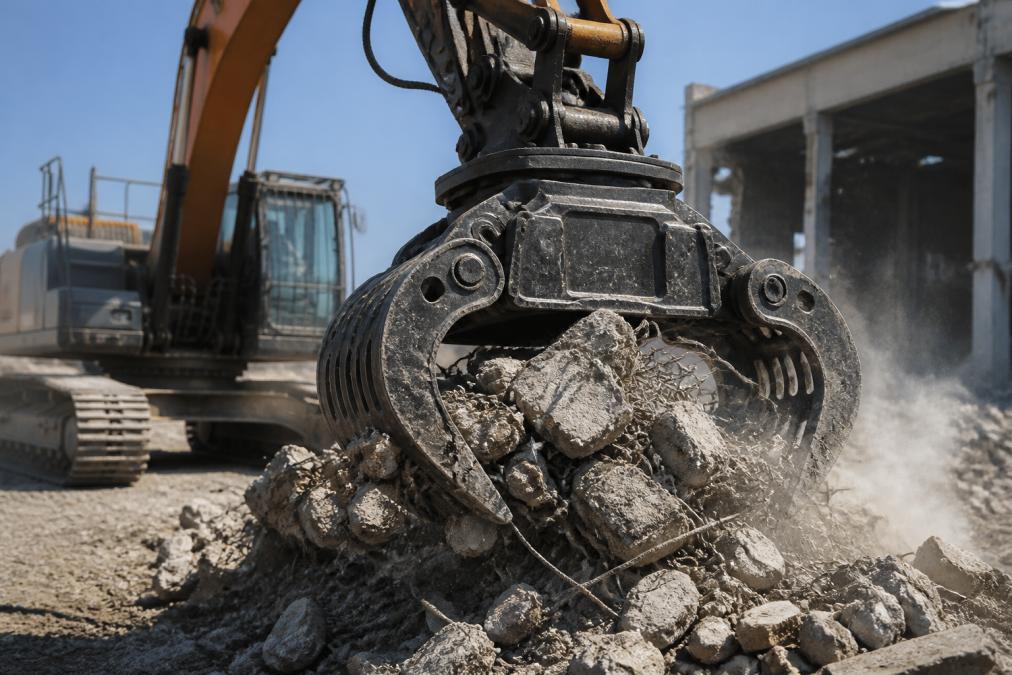
Pivot and pin quality is the next check. Heavy duty grapples use hardened, chromed steel pins with replaceable bushings and protected grease nipples. If grease points are exposed, they will clog with dust and the pins will wear rapidly. A common mistake is overlooking the cylinder. Look for a high-pressure cylinder with double piston rod seals, which prevents the oil leaks that plague cheaper units after a few months of operation.
Rotation matters more than most buyers expect. A grapple with a hydraulic rotator lets you orient the load precisely without repositioning the excavator, which improves operational efficiency. However, a rotator requires a second auxiliary circuit, so confirm your machine's hydraulic flow requirements before purchasing.
Matching Grapple Size to Your Excavator Weight Class
The most common purchasing error is selecting a grapple based on physical size rather than excavator weight class. A grapple must be matched to the machine's lifting capacity and hydraulic output, not just the pin diameter. An undersized excavator cannot safely control a large grapple, while an oversized machine will overpower a small unit and cause structural failure.
Manufacturers rate grapples for specific weight classes, typically expressed in tonnes. For example, a grapple rated for 1 to 2 tonne mini excavators suits machines such as a Kubota KX41 or a Takeuchi TB216, with pin sizes of 25mm, 30mm, or 32mm. Fitment verification is critical here; head brackets are often made to order, so you must provide your machine's make, model, and coupler type to avoid costly modifications.
The Intermercato Hydraulic Grab 1 - 2T with Single Ram at Earthmoving Warehouse is a strong example of correct sizing. It is rated for 1 to 2 tonne excavators, weighs 60kg, opens to 810mm, and features five tines made from Hardox 400H. The head brackets are manufactured to order, which means the grapple is built to fit your specific machine rather than requiring grinding and modification on site.

Demolition Grapple Safety Standards in Australia
Demolition grapple safety standards in Australia are governed by work health and safety regulations, which place the duty of care on the person conducting a business or undertaking (PCBU). Under the Work Health and Safety Act 2011, the PCBU must ensure plant and structures are safe and without risks to health. This includes verifying that attachments are compatible with the excavator and rated for the work being performed.
The practical implication is straightforward: you must confirm the grapple's rated capacity exceeds the heaviest load you intend to lift, and you must follow the manufacturer's instructions for fitment and use. An attachment that fails because it was matched incorrectly to the machine creates a serious risk of dropped loads or structural failure. Safe Work Australia provides guidance on plant safety, and it is worth reviewing Safe Work Australia's guidance on plant before introducing new attachments to your fleet.
Load capacity is not the only safety consideration. Operator visibility and control precision affect safety on site. A grapple with smooth, responsive hydraulic control allows the operator to place loads accurately without sudden movements, reducing the risk of crushing injuries or damage to nearby plant.
Excavator Grapple Attachment Maintenance for Long Service Life
Excavator grapple attachment maintenance is the difference between a grapple that lasts a decade and one that fails within a season. The maintenance regime is simple but demands discipline, because demolition environments accelerate wear dramatically.
Greasing is the most critical task. Pivot pins should be greased every 8 to 10 hours of operation, which means daily greasing on most sites. Use a quality lithium-based grease and pump until fresh grease purges from the bushings, which flushes out abrasive dust. Check that all grease nipples are protected and replace any that are damaged, because a broken nipple allows contaminants into the pin assembly.
Inspect the hydraulic cylinder and hoses weekly. Look for scoring on the piston rod, which indicates contamination in the hydraulic fluid, and check hoses for chafing where they rub against the grapple structure. Guidance from the Australian Hydraulic Council on cylinder maintenance recommends replacing worn seals immediately rather than waiting for a visible leak, because internal bypass wastes flow and reduces clamping force long before oil appears externally.
Wear surfaces also need attention. The tines and cutting edges will wear with use; build-up welding can restore them, but only if the base material is still sound. Regularly check the weld joints between the tines and the main frame for cracking, particularly after heavy impact work. A small crack that is ground out and re-welded is a minor repair; a crack that runs the full length of a weld joint can result in a catastrophic failure.
The Bottom Line on Choosing a Demolition Grapple
Choosing the right demolition grapple comes down to matching the unit to your excavator's weight class, verifying the hydraulic flow requirements, and inspecting the steel and pivot quality. A grapple built from high-strength steel with hardened pins and a protected cylinder will deliver years of service, while a cheap unit will cost more in downtime and replacement than you saved on the purchase price.
For mini excavator operators, the Intermercato Hydraulic Grab 1 - 2T with Single Ram at $4,510.00 delivers the durability you need. It is made in Sweden from Hardox 400H, includes a double pin hitch with hoses and couplers of your choice, and the head brackets are manufactured to order so it fits your machine without modification. At Earthmoving Warehouse, we stock attachments designed for Australian conditions, and our team can verify fitment before you order. Request a price and get a grapple that is rated for the work you do.
Frequently Asked Questions
What features define a heavy-duty demolition grapple?
A heavy-duty demolition grapple is defined by its construction materials and hydraulic specifications. Look for tines made from high-strength, wear-resistant steel like HARDOX, reinforced bodies with hardened pivots, and a clamping force matched to your excavator's hydraulic flow and pressure. The grapple must also have sufficient bunching capacity and tine penetration for effective material handling, sorting, and rubble management on a demolition site.
How do I choose the right grapple size for my excavator?
Match the grapple to your excavator's weight class, not just the bucket size. A grapple rated for a 1 to 2-tonne machine will fail quickly on a 5-tonne excavator due to higher breakout forces. Check the grapple's weight, opening width, and required hydraulic flow against your machine's specifications. For example, the Intermercato Hydraulic Grab is rated for 1-2T mini excavators with 25mm, 30mm, or 32mm pins, ensuring a proper fit.
What is the difference between a sorting grapple and a demolition grapple?
A sorting grapple is designed for precise material handling, like picking out specific items from debris for recycling. It often has more tines and a tighter grip for selectivity. A demolition grapple is built for brute force tasks like tearing down structures and handling large, heavy rubble. It prioritises clamping force, structural integrity, and resistance to impact damage over fine control, making it suitable for the most punishing site conditions.
What maintenance is required for demolition grapples to ensure longevity?
Regular maintenance is essential for a long service life. Grease all pivot points and pins daily, or every 8 to 10 hours of operation, to prevent friction wear. Inspect hydraulic hoses and couplers for leaks or damage before each shift. Periodically check the tines and body for cracks or bending, especially after heavy impacts. Following these steps prevents costly downtime and extends the operational life of your excavator grapple attachment.
How do I ensure my grapple attachment complies with Australian safety standards?
Ensure the grapple is correctly rated for your excavator's weight and hydraulic system to prevent structural failure. All attachments must be compatible with your machine's quick coupler and meet Australian design and engineering standards. Always follow the manufacturer's instructions for safe operation and maintenance. For specific compliance requirements on your site, consult with a qualified engineer or your state's workplace health and safety regulator.


