



Last Updated: November 7, 2026
Quick Summary
To reduce excavator attachment delivery delays, confirm pin dimensions, coupler type and hydraulic flow before you order, and agree the lead time in writing. Plan backwards from the date you need the attachment working, add contingency at each stage, and confirm site access and unloading before dispatch.
- Compatibility is the number one cause of rework and reshipment of attachments.
- A practical order-to-delivery timeline has five milestones, each confirmed in writing.
- Add contingency separately for supplier lead time, freight transit and site readiness.
- Confirm gate widths, turning space and ground conditions before booking the delivery.
- Ask for a spec sheet or photo before dispatch to catch fitment errors early.
Table of Contents
- Why Excavator Attachment Delivery Delays Cost More Than the Freight
- Get Excavator Attachment Compatibility Right Before You Order
- The Excavator Attachment Ordering Checklist That Prevents Rework
- Planning Your Excavator Attachment Lead Time Around the Project Programme
- Site Access, Transport and Unloading Logistics
- Excavator Attachment Delivery Tracking and Supplier Communication
- Pre-Delivery Verification and Delay Contingency Plans
- Request a Price and Confirm Fitment Before You Book
- Frequently Asked Questions
Why Excavator Attachment Delivery Delays Cost More Than the Freight
A late attachment does more than miss a delivery window. It parks a machine, idles an operator, and pushes back every task scheduled behind it.
The freight charge is the smallest part of the loss. A single delayed excavator attachment can stall a civil project for a week or more.
Most delays start well before dispatch. They start with a vague order, a mismatched coupler, or a site that can't take the truck. Below, we'll show you how to close those gaps so your attachment arrives when you need it.
Get Excavator Attachment Compatibility Right Before You Order
Compatibility is the number one cause of rework and reshipment. Get it wrong and the attachment either won't pin up or won't run at full power. Both outcomes cost you days.
Pin dimensions, coupler type and hydraulic flow
Measure before you order. Record the pin diameter, the pin centre spacing, and the dipper width. Note whether your machine runs a quick coupler, and if so, which style. These numbers decide fitment.
Hydraulic flow and pressure matter just as much. An attachment sized for a higher flow rate will run slow and weak on a smaller carrier. Check the flow and pressure your machine delivers, then match the attachment to it.
- Pin diameter and centre spacing
- Coupler type and style
- Hydraulic flow rate and pressure
- Machine operating weight
Matching the attachment to machine size and job requirements
A bucket, breaker, or grab must suit both the carrier and the work. An attachment that's too heavy for the machine strains the boom and slows cycle times. One that's too light won't break the rock you're facing.

Match tonnage to the task. Tell your supplier the machine class, the material, and the duty cycle. If you run a mixed fleet, list every machine and its setup so one order can cover them all. Verifying fitment before dispatch is where many mismatches can be caught.
The Excavator Attachment Ordering Checklist That Prevents Rework
A short checklist up front prevents most delivery delays. Work through it before you confirm any order, and keep a copy for each machine in your fleet.
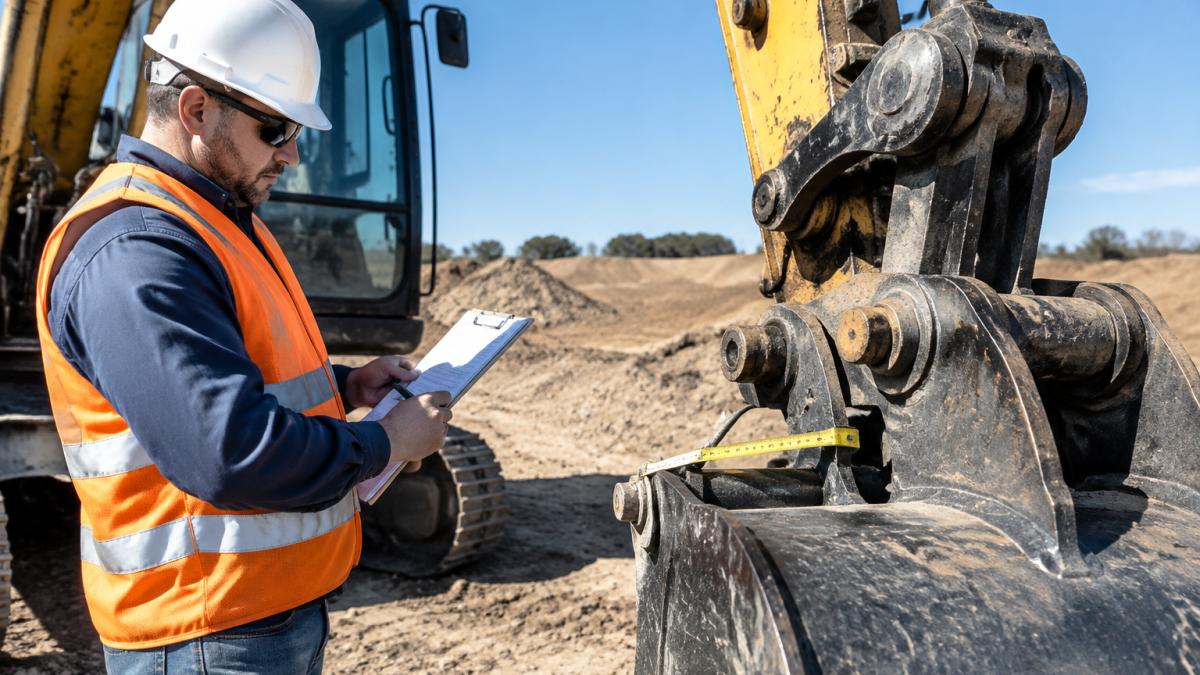
- Machine make, model and operating weight recorded
- Pin diameter and centre spacing measured
- Coupler type and style confirmed
- Hydraulic flow and pressure checked
- Attachment type and size matched to the job
- Delivery address and site access confirmed
- Unloading method and equipment arranged
- Lead time agreed in writing
- Payment and freight terms settled
Run this list every time. It takes minutes and saves days. If you're ordering a compaction wheel for a specific tonnage, confirm the model against the checklist before you commit.
Work through these checks before confirming any order to prevent most delivery delays.
| Check | What to confirm |
|---|---|
| Machine details | Make, model and operating weight recorded |
| Pin dimensions | Pin diameter and centre spacing measured |
| Coupler | Coupler type and style confirmed |
| Hydraulics | Flow and pressure checked |
| Attachment | Type and size matched to the job |
| Delivery | Address and site access confirmed |
| Unloading | Method and equipment arranged |
| Terms | Lead time, payment and freight settled |
Planning Your Excavator Attachment Lead Time Around the Project Programme
Lead time is the gap between order confirmation and the attachment being unloaded on site, and it rarely stays fixed. Stock items move fast; made-to-order or specialised attachments take longer. Plan backwards from the date you need the attachment working, not from the day you place the order, and build the programme around confirmed milestones rather than assumed ones.
Order-to-delivery timeline and milestone planning
A practical order-to-delivery timeline has five milestones. Confirm each one in writing so a slip at any stage is visible before it becomes a site delay.
- Order confirmation, the supplier acknowledges the order, the attachment model, the fitment details, and the agreed lead time in writing.
- Fitment verification, pin dimensions, coupler type, hydraulic flow and pressure are checked against your machine before the attachment enters production or dispatch.
- Production or stock allocation, for made-to-order items, confirm the build slot; for stock items, confirm the unit is allocated to your order rather than sitting in a general pool.
- Dispatch confirmation, the supplier confirms the dispatch date, the freight carrier, and the tracking reference.
- Delivery window, the carrier confirms the expected arrival window, and you confirm the site can receive it.
Work backwards from the on-site date. If the attachment is on the critical path, order earlier than feels necessary and treat each milestone as a checkpoint rather than a formality. A common pattern is for contractors to confirm the order and then go silent until dispatch, which is exactly when a fitment query or a stock shortfall has the least time to be resolved.
Building contingency time around supplier, transport and project schedules
Add contingency at each stage, not just one lump at the end. Supplier lead time, freight transit, and your own site readiness each carry their own risk, and they compound when a project is running tight.
- Add buffer for supplier stock levels and custom fitment, especially on made-to-order attachments.
- Add buffer for freight transit and weather, particularly for regional or remote deliveries.
- Add buffer for site access and unloading, which is where many deliveries actually slip.
- Identify the attachment's float in the programme, how much it can slip before it delays the next trade.
If a ripper or breaker is central to your programme, check availability early rather than assuming it is on the shelf.
Watch out: treating the supplier's quoted lead time as a fixed date rather than an estimate. Lead times move with stock and freight, so confirm the dispatch date at the milestone rather than relying on the original quote.
Site Access, Transport and Unloading Logistics
Many delays happen at the gate, not the factory. A truck that cannot get in, or an attachment with no way off the tray, turns a delivery into a lost day. Confirm the access route and unloading plan before dispatch, and put the checks in writing so the carrier and the site crew are working from the same information.
Truck access, turning space and ground conditions
A loaded truck needs more room than an empty one. Check the route from the nearest suitable road to the unloading point, and confirm the following before you book the delivery:
- Gate widths and overhead clearance, measure the narrowest point on the route and the lowest overhead obstruction, including power lines and tree limbs.
- Turning space, a loaded rigid truck or semi-trailer needs room to turn and to reverse to the drop point. If the site is tight, arrange a smaller vehicle or a nearby transfer point.
- Ground conditions, a loaded truck needs a firm, level surface to stand on. Soft ground, recently graded areas, and steep grades can stop a delivery or cause the truck to bog.
- Delivery windows, confirm the hours the site can receive a truck, and check whether the local road network or site rules restrict heavy vehicle access at certain times.
Permits, unloading areas and delivery windows
Some deliveries need more than a clear route. Oversize or heavy loads may require permits or pilot vehicles, and some sites require booking a delivery slot with site management.
Plan the unloading itself. You need the right machine or crane on hand when the truck arrives, an operator and a spotter ready, and the unloading area cleared in advance.
Watch out: booking a delivery for a day when no one can unload it. The truck waits, and the attachment sits on the tray, a delay that comes down to site readiness.
Excavator Attachment Delivery Tracking and Supplier Communication
Silence is where delays hide. Ask for a dispatch date and a tracking reference, and check in at agreed points rather than waiting for news.
Keep one point of contact on both sides. Confirm the delivery window a day ahead, and flag any site changes early. If something slips, you want to hear it from your supplier before the truck leaves, not after.
- Get the dispatch date in writing
- Ask for tracking or freight details
- Confirm the delivery window the day before
- Report site changes as soon as they happen
Good communication turns a potential delay into a quick reshuffle. Poor communication turns it into a week of downtime.
Pre-Delivery Verification and Delay Contingency Plans
Verify the attachment before it ships. Ask your supplier to confirm the model, pin setup, and hydraulic connections against your order. A photo or spec sheet before dispatch catches errors while they're still cheap to fix.
Have a contingency plan for the jobs that can't wait. Keep a spare bucket or breaker on hand, or know which hire option can cover the gap. If a delay hits, resequence tasks so the idle machine has something to do.
- Confirm model and fitment before dispatch
- Request a spec sheet or photo
- Keep a backup attachment for critical work
- Know your hire options in advance
A pre-delivery check and a simple backup plan are what separate a minor hiccup from a stalled project.
Request a Price and Confirm Fitment Before You Book
The best way to cut delivery delays is to get fitment and lead time right at the start.
Earthmoving Warehouse supplies attachments designed to withstand rugged Australian conditions, with an expert team that can help verify fitment.
Get started with Earthmoving Warehouse and confirm the right attachment, fitment and lead time before your next job.
Don't let a mismatched attachment or a missed delivery window stall your next project. Our team can check compatibility and availability before you order, so the right gear arrives when you need it.
Frequently Asked Questions
How far in advance should I order an excavator attachment?
Work backwards from the date the machine needs to be productive, not the date you want it delivered. Build in time for fitment confirmation, dispatch, freight to a regional site and a buffer for weather or transport hold-ups. Specialised items such as rock breakers or augers for less common carriers usually need more notice than a standard bucket. Confirm the current lead time with your supplier in writing when you order, then add your own contingency on top rather than relying on the supplier's estimate alone.
What information do I need to check excavator attachment compatibility?
Record the machine make, model and year, the pin diameter and pin centre spacing, the coupler type if one is fitted, and the hydraulic flow and pressure your machine delivers. Photograph the existing attachment mounting points and the coupler from a few angles. Send all of it to the supplier before ordering so they can verify fitment. Incorrect or estimated measurements are one of the most common reasons an excavator attachment arrives and will not mount, which turns a short delay into a full rework cycle.
What can delay excavator attachment delivery?
The usual culprits are unconfirmed fitment details, attachments built to order rather than held in stock, transport booked without checking site access, and delivery windows agreed without anyone on site to receive and unload. Public holidays and peak construction periods add pressure on freight. Poor communication between the person who ordered and the person running the machine also causes problems, because nobody notices a mismatch until the truck arrives. A written checklist and a named contact on both sides removes most of these risks.
What should I do if an excavator attachment delivery is delayed?
Ask the supplier for the specific cause and a revised dispatch date, not a vague assurance. Check whether a substitute attachment or a loan unit can keep the machine working in the meantime, and whether the delay affects a hire contract you can adjust. Update your site programme the same day so crews are not standing idle. Then review what failed in your own ordering process, whether that was a measurement, a lead time assumption or a missing delivery window, so the next order does not repeat it.


